ISSN 2097-6054(网络) ISSN 1672-9234(印刷) CN 11-5289/R
主管:中国科学技术协会 主办:中华护理学会
出版:中华护理杂志社
收录:中国科学引文数据库(CSCD)来源期刊
   中国期刊全文数据库
   中国核心期刊(遴选)数据库
   Scopus

中华护理教育 ›› 2026, Vol. 23 ›› Issue (7): 778-783.doi: 10.3761/j.issn.1672-9234.2026.07.002

• 专题策划——教学设计创新 • 上一篇    下一篇

人工智能赋能护理心理学课程思政教学改革与实践

高云1(), 苏茜1, 杜志敏1, 周英1, 唐秋碧2, 廖晓艳1,*()   

  1. 1 广州医科大学护理学院 广州市 511436
    2 广州医科大学附属脑科医院神经科 广州市 510370
  • 收稿日期:2026-01-25 出版日期:2026-07-15 发布日期:2026-07-17
  • 通讯作者: *廖晓艳,E-mail:liaoxy@gzhmu.edu.cn
  • 作者简介:高云:女,博士,教授,E-mail:309972171@qq.com
    第一联系人:

    研究构思与设计为廖晓艳、高云、周英、苏茜、杜志敏、唐秋碧,论文撰写、数据收集与处理为高云,论文修改与审校为廖晓艳。

  • 基金资助:
    广东省教育科学规划课题(2024GXJK419)

Smart reform and practice of ideological and political education in Nursing Psychology course

GAO Yun1(), SU Xi1, DU Zhimin1, ZHOU Ying1, TANG Qiubi2, LIAO Xiaoyan1,*()   

  1. 1 School of NursingGuangzhou Medical UniversityGuangzhou 511436, China
    2 Department of Neurologythe Affiliated Brain Hospital of Guangzhou Medical UniversityGuangzhou 510370, China
  • Received:2026-01-25 Online:2026-07-15 Published:2026-07-17
  • Contact: *LIAO Xiaoyan,E-mail:liaoxy@gzhmu.edu.cn
  • Supported by:
    Guangdong Province Education Science Planning Project(2024GXJK419)

摘要:

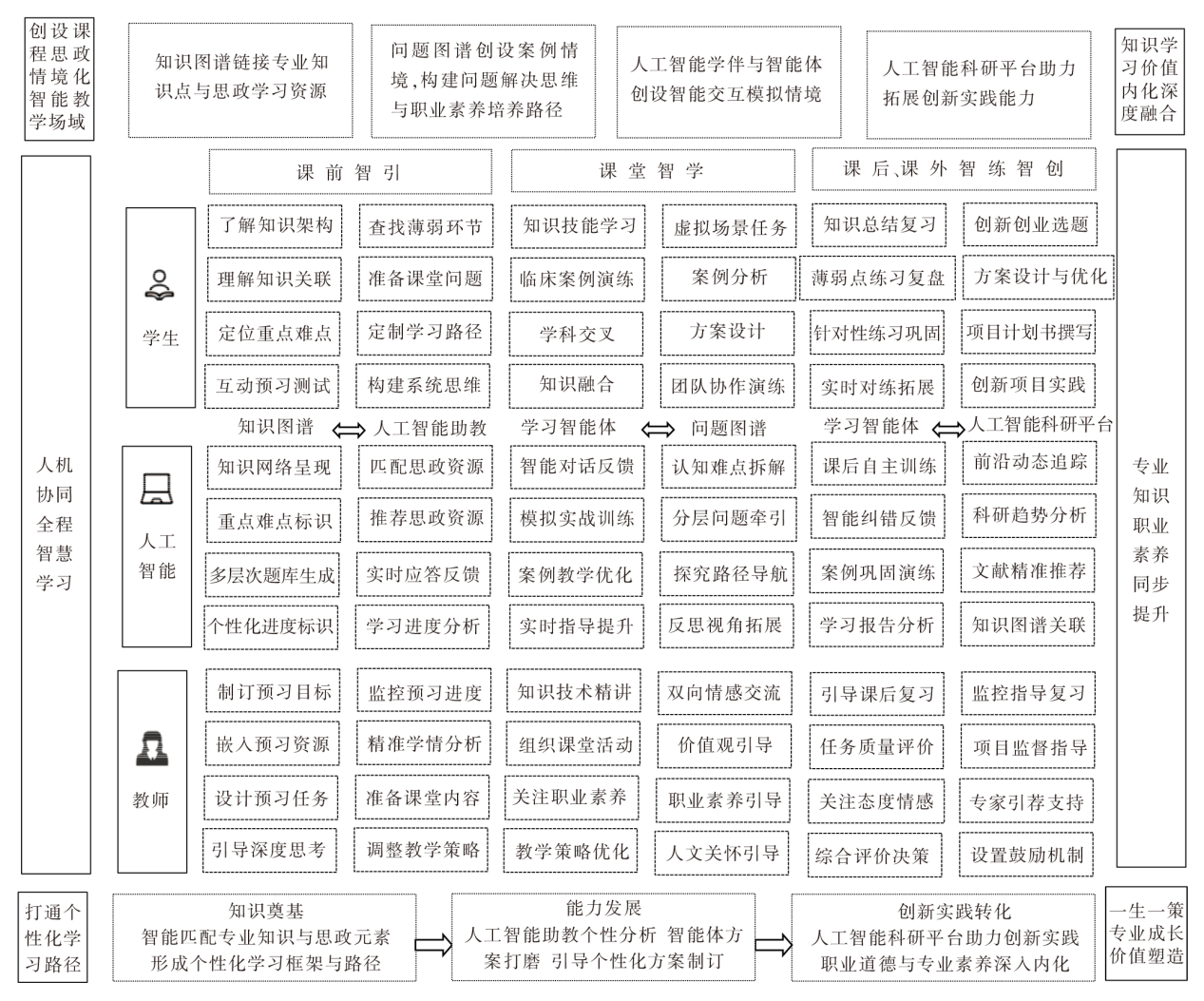
目的 探讨人工智能赋能护理心理学课程思政教学的实践方法与效果。方法 创设课程思政情境化智能教学场域、构建并实施“课前智引,课中智学,课后、课外智练、智创”的全过程智慧化思政教学融合教学方案。以广州某医科大学2023级护理学专业135名本科生为研究对象进行教学,与改革前的2022级学生(n=133)比较理论考核成绩,比较教学前后的学生心理健康素养评分,采用结构化观察笔记收集教师对学生职业道德与人文关怀表现的评价反馈。结果 2023级学生的理论考核成绩为(72.76±7.38)分,高于2022级学生的(70.23±8.72)分,差异有统计学意义(P=0.01);2023级学生的心理健康素养总分教学后为(112.18±10.74)分,高于教学前的(108.67±10.85)分,差异有统计学意义(P<0.01);在情境模拟中,学生在职业道德与人文关怀良好行为出现比例达75%~100%。结论 人工智能赋能护理心理学课程思政教学改革有助于提升学生专业知识掌握水平和心理健康素养,促进形成良好职业道德与人文关怀表现,为护理专业课程思政智慧化改革提供了实践范例。

关键词: 护理心理学, 课程思政, 知识图谱, 人工智能, 教学改革

Abstract:

Objective To explore the practical approaches and effects of artificial intelligence-empowered ideological and political education in the Nursing Psychology course. Methods A situational intelligent teaching field for ideological and political education was created,and a whole-process intelligent teaching and ideological integration scheme covering “pre-class intelligent guidance,in-class intelligent learning,after-class/extracurricular intelligent practice and innovation” was constructed and implemented. A total of 135 undergraduate nursing students recruited in 2023 at a medical university in Guangzhou were recruited. A historical control design was used to compare theoretical examination scores between the 2023 cohort and the 2022 cohort(n=133). A pretest-posttest self-controlled design was applied to evaluate mental health literacy. Structured observation notes were used to collect feedback from teachers on students’ performance in terms of professional ethics and humanistic care. Results The theoretical examination scores of the reformed group(72.76±7.38) were higher than those of the historical control group(70.23±8.72),and the difference was statistically significant(P=0.01). The post-test total score of mental health literacy(112.18±10.74) was higher than the pre-test score(108.67±10.85),and the difference was statistically significant(P<0.01). Scenario simulation observations revealed that the proportion of students demonstrating good professional ethics and humanistic care behaviors ranged from 75% to 100%. Conclusion The artificial intelligence-empowered ideological and political education scheme in the Nursing Psychology course helps improve students’ theoretical knowledge mastery and mental health literacy,promotes the formation of ethical-humanistic conduct,and provides an operable practical example for the smart reform of ideological and political education in nursing programs.

Key words: Nursing Psychology, Ideological and Political Education, Knowledge Graph, Artificial Intelligence, Teaching Reform