ISSN 2097-6054(网络) ISSN 1672-9234(印刷) CN 11-5289/R
主管:中国科学技术协会 主办:中华护理学会
出版:中华护理杂志社
收录:中国科学引文数据库(CSCD)来源期刊
   中国期刊全文数据库
   中国核心期刊(遴选)数据库
   Scopus

中华护理教育 ›› 2026, Vol. 23 ›› Issue (2): 202-207.doi: 10.3761/j.issn.1672-9234.2026.02.012

• 实验与实践教学研究 • 上一篇    下一篇

知识图谱支持下的案例联合研讨式教学在神经内科护理带教中的应用研究

徐佳琪(), 顾志娥*(), 颜妍, 施杨, 王敏, 祝娉婷, 万小娟, 胡娅莉, 刘必琴, 陈露, 于海龙   

  1. 扬州大学医学部护理学院 扬州市 225009
  • 收稿日期:2025-09-30 出版日期:2026-02-15 发布日期:2026-02-11
  • 通讯作者: * 顾志娥,E-mail:yzguzhie@163.com
  • 作者简介:徐佳琪:女,本科(硕士在读),护士,E-mail:xujiaqi1206@163.com
  • 基金资助:
    扬州大学护理学院·公共卫生学院教改课题(HLYG2025-3)

Application of CBL combined with seminar teaching method supported by knowledge graph in teaching of neurology nursing interns

XU Jiaqi(), GU Zhie*(), YAN Yan, SHI Yang, WANG Min, ZHU Pinting, WAN Xiaojuan, HU Yali, LIU Biqin, CHEN Lu, YU Hailong   

  1. School of Nursing,Yangzhou University,Yangzhou 225009,China
  • Received:2025-09-30 Online:2026-02-15 Published:2026-02-11
  • Contact: * GU Zhie,E-mail:yzguzhie@163.com
  • Supported by:
    Teaching Reform Research Project of School of Nursing and Public Health,Yangzhou University(HLYG2025-3)

摘要:

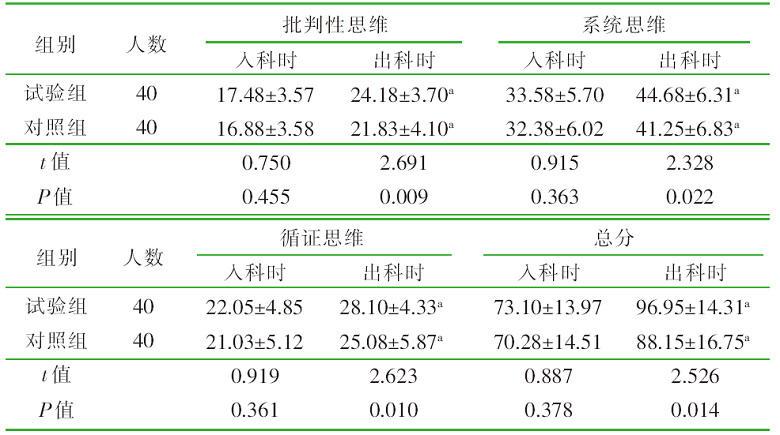
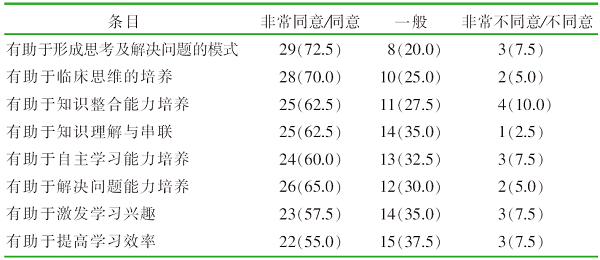
目的 探究知识图谱支持下的案例联合研讨式教学在神经内科本科护理实习生中的应用效果。方法 通过本体构建、知识抽取、知识融合、知识存储与可视化构建以脑血管疾病为主的神经内科护理知识图谱。采用类实验研究设计,将2023年6月1日—2024年3月31日入该院神经内科实习的40名护理本科生作为对照组,2024年6月1日—2025年3月31日入科实习的40名护理本科生作为试验组。对照组接受传统教学,试验组接受知识图谱支持下的案例联合研讨式教学。比较两组入科及出科理论考核成绩、临床思维能力评分,评估试验组对教学的认同情况,通过访谈了解试验组、带教教师在教与学中的收获及对教学的建议等。结果 出科时试验组理论考核成绩、临床思维能力评分均优于对照组(P<0.05)。试验组中72.5%的学生认同教学有助于形成思考及解决问题的模式。试验组、带教教师认为教学有助于提升学习兴趣及教学效率、促进学习迁移等,但其深化应用仍面临挑战。结论 知识图谱支持下的案例联合研讨式教学能够提升神经内科本科护理实习生的理论知识水平,培养其临床思维,提高师生教与学的效果。

关键词: 知识图谱, 案例教学法, 研讨式教学法, 护理实习生, 本科, 神经内科

Abstract:

Objective To explore the effectiveness of the Case-Based Learning(CBL) combined with Seminar teaching method supported by knowledge graph in the clinical teaching of undergraduate nursing interns in the Neurology Department. Methods A knowledge graph for neurological diseases,focusing on cerebrovascular diseases,was constructed through ontology construction,knowledge extraction,knowledge fusion,knowledge storage,and visualization. Fourty nursing students who entered the department from June 1,2023 to March 31,2024 were assigned to the control group,and 40 nursing students who entered the department from June 1,2024 to March 31,2025 were assigned to the experimental group. The control group carried out teaching activities using traditional methods,while the experimental group adopted the CBL combined with seminar teaching method supported by knowledge graph. Theoretical knowledge scores(upon entry and exit of the department) and clinical thinking ability were compared between groups. The experimental group’s acceptance of the teaching method was surveyed,and semi-structured interviews were conducted with students and clinical teachers to explore their experiences and suggestions. Results The experimental group outperformed the control group in both theoretical assessment scores and clinical thinking ability scores(P<0.05). Among nursing students in the experimental group,72.5% believed that the teaching mode was helpful for forming a pattern of thinking and solving problems. Both teachers and students acknowledged its benefits in enhancing learning interest,teaching efficiency,and learning transfer,however,while noting that its deeper implementation faced challenges. Conclusion The CBL combined with seminar teaching method supported by knowledge graph can improve the theoretical knowledge acquisition,cultivate clinical thinking,and improve teaching and learning outcomes for undergraduate nursing interns in neurology.

Key words: Knowledge Graph, Case-Based Learning, Seminar Teaching Method, Nursing Interns, Undergraduate, Neurology Department