ISSN 2097-6054(网络) ISSN 1672-9234(印刷) CN 11-5289/R
主管:中国科学技术协会 主办:中华护理学会
出版:中华护理杂志社
收录:中国科学引文数据库(CSCD)来源期刊
   中国期刊全文数据库
   中国核心期刊(遴选)数据库
   Scopus

中华护理教育 ›› 2026, Vol. 23 ›› Issue (11): 1373-1379.doi: 10.3761/j.issn.1672-9234.2026.11.014

• 专业实践研究 • 上一篇    下一篇

知识图谱与大语言模型协同驱动的老年吞咽障碍管理辅助决策系统构建与可用性评价

李素芳1(), 王嘉煜2, 杜羿霏3, 赵清1, 苏盼盼1, 陶又箐1, 杨雯雯1,*()   

  1. 1 郑州大学附属肿瘤医院(河南省肿瘤医院)头颈外科 郑州市 450008
    2 河南中医药大学护理学院(智慧康养护理行业学院) 郑州市 450046
    3 郑州大学附属肿瘤医院(河南省肿瘤医院)重症医学科 郑州市 450008
  • 收稿日期:2026-06-05 出版日期:2026-11-15 发布日期:2026-11-04
  • 通讯作者: *杨雯雯,E-mail:1617159790@qq.com
  • 作者简介:李素芳:女,本科,副主任护师,E-mail:fangfang776366@163.com
    第一联系人:

    研究构思与设计为李素芳、杨雯雯;系统开发与技术实现为王嘉煜、杜羿霏;数据收集与处理为赵清、苏盼盼、陶又箐;论文撰写为李素芳、杨雯雯;英文修订为杜羿霏;论文修改与审校为杨雯雯。

  • 基金资助:
    河南省医学科技攻关计划联合共建项目(LHGJ20260203)

Construction and usability evaluation of a knowledge graph and large language model co-driven management decision-support system for dysphagia in older adults

LI Sufang1(), WANG Jiayu2, DU Yifei3, ZHAO Qing1, SU Panpan1, TAO Youqing1, YANG Wenwen1,*()   

  1. 1 Department of Head and Neck Surgery, the Affiliated Cancer Hospital of Zhengzhou University & Henan Cancer Hospital, Zhengzhou 450008, China
    2 School of Nursing & Nursing School of Smart Healthcare Industry, Henan University of Chinese Medicine, Zhengzhou 450046, China
    3 Intensive Care Unit, the Affiliated Cancer Hospital of Zhengzhou University & Henan Cancer Hospital, Zhengzhou 450008, China
  • Received:2026-06-05 Online:2026-11-15 Published:2026-11-04
  • Contact: *YANG Wenwen,E-mail:1617159790@qq.com
  • Supported by:
    Henan Medical Science and Technology Research Joint Construction Project(LHGJ20260203)

摘要:

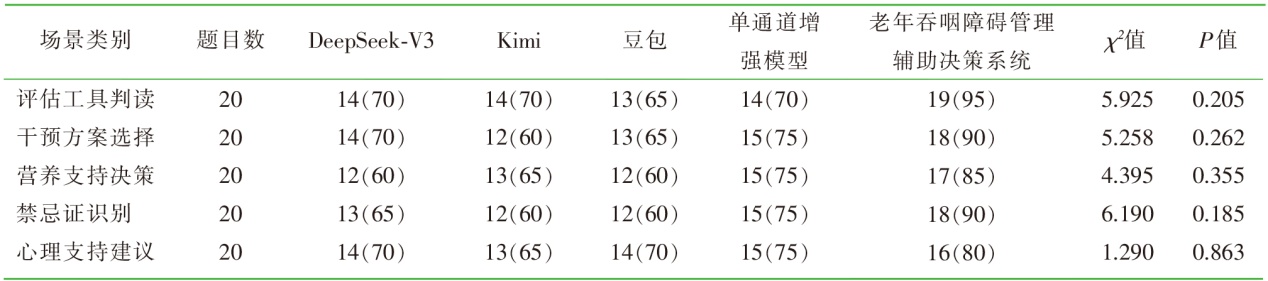
目的 构建知识图谱与大语言模型驱动的老年吞咽障碍管理辅助决策系统(简称系统),并评价其可用性。方法 依托Protégé平台、以自顶向下与自底向上相结合的方法构建老年吞咽障碍知识图谱;以语料库与知识图谱为双重知识源,经向量语义检索与图谱子图检索双通道分别实现文献证据召回与有向因果推理,以DeepSeek-V3为生成模型并引入多模型一致性校验;以护士为核心使用者,家庭照护者与患者为延伸端,分别面向护士、家庭照护者和患者预置差异化提示模板。从模型层、决策层和用户层对系统的性能与可用性展开评价。结果 系统在基于老年吞咽障碍的标准化测试中应答准确率为88%,高于通用模型的64%~67%(P<0.001)与单通道模型的74%(P=0.012)。13名专家对系统基于病例输出的辅助决策方案评价中,证据可溯源性维度评分最高[(4.42±0.17)分]。10名头颈外科护士、10名家庭照护者试用系统2周后对系统的可用性评分依次为(80.25±7.12)分、(74.50±8.80)分;对其中3名护士、3名家庭照护者的访谈资料分析结果显示,系统有助于提升决策可信度与效率、家庭照护者的照护技能水平,但在术语转译及对重度病例的应答深度方面仍待优化。结论 系统应答准确率较高且可实现证据的溯源,其在临床与家庭情境下的老年吞咽障碍管理辅助决策中具有良好的可用性。


关键词: 吞咽障碍, 老年人, 决策支持系统, 临床, 人工智能, 知识图谱

Abstract:

Objective To develop a management decision-support system integrating a knowledge graph with a large language model for dysphagia in older adults,and to evaluate its usability. Methods A disease-specific knowledge graph was built in Protégé through a combined top-down and bottom-up approach. With a text corpus and the knowledge graph serving as dual knowledge sources,two parallel channels:vector-based semantic retrieval and subgraph retrieval,respectively retrieved supporting evidence from the literature and performed directed causal reasoning. DeepSeek-V3 was adopted as the generative foundation model,supplemented by a cross-model consistency check. Clinical nurses were positioned as the primary users,with family caregivers and patients as extension users in home settings;role-tailored prompt templates and an emotional safety control mechanism were predefined for these user groups. Role-specific prompt templates were predefined for nurses,family caregivers,and patients. The system was evaluated at three levels:model performance,decision output,and user experience. Results The system achieved a response accuracy of 88% in standardized tests for geriatric dysphagia,significantly higher than that of the general-purpose models(64%-67%,P<0.001) and the single-channel model(74%,P=0.012). In the evaluation of the system-assisted decision-making scheme by 13 experts,the evidence trace ability dimension achieved the highest score of(4.42±0.17). The system usability scores were 80.25±7.12 for 10 nurses and 74.50±8.80 for 10 caregivers. The analysis of interview data from 3 nurses and 3 caregivers revealed that the system strengthened the credibility and efficiency of decisions and improved caregivers’ practical skills,although the translation of technical terms and the depth of responses for severe cases warranted further refinement. Conclusion The system delivers high response accuracy and enables evidence traceability,showing favorable usability for assisted decision-making in the management of geriatric dysphagia in both clinical and home settings.

Key words: Dysphagia, Aged, Decision Support Systems, Clinical, Artificial Intelligence, Knowledge Graph