| [1] |
国家卫生健康委办公厅. 安宁疗护实践指南(2025年版)[EB/OL].(2025-08-01)[2025-12-28]. https://www.gov.cn/zhengce/zheng-ceku/202508/content_7037917.htm.
|
|
General Office of the National Health Commission. Guidelines for hospice and palliative care practice(2025 edition)[EB/OL].(2025-08-01)[2025-12-28]. https://www.gov.cn/zhengce/zhengce-ku/202508/content_7037917.htm.
|
| [2] |
顾玲玲, 谌永毅, 蒋艳, 等. 安宁疗护患者人文关怀专家共识[J]. 中华护理杂志, 2025, 60(18):2181-2184.
|
|
Gu LL, Chen YY, Jiang Y, et al. Expert consensus on humani-stic care for patients in hospice care[J]. Chin J Nurs, 2025, 60(18):2181-2184.
|
| [3] |
王丹, 陈群, 王艳波, 等. 临床护士为终末期患者实施本土化叙事护理的体验[J]. 中国护理管理, 2024, 24(2):181-186.
|
|
Wang D, Chen Q, Wang YB, et al. Clinical nurses’ experience of implementing localized narrative nursing for terminal patients[J]. Chin Nurs Manag, 2024, 24(2):181-186.
|
| [4] |
周晓玥, 余婷. 叙事教育在护理专业实习生临床带教中的应用[J]. 昆明医科大学学报, 2024, 45(5):190-194.
|
|
Zhou XY, Yu T. The application of narrative education in the clinical teaching of nursing interns[J]. J Kunming Med Univ, 2024, 45(5):190-194.
|
| [5] |
Dai LL, Han YQ, Jiang QH, et al. The impact of practical training based on narrative nursing on the humanistic care ability of Chinese intern nurses[J]. Front Med, 2025, 12:1635846.
doi: 10.3389/fmed.2025.1635846
|
| [6] |
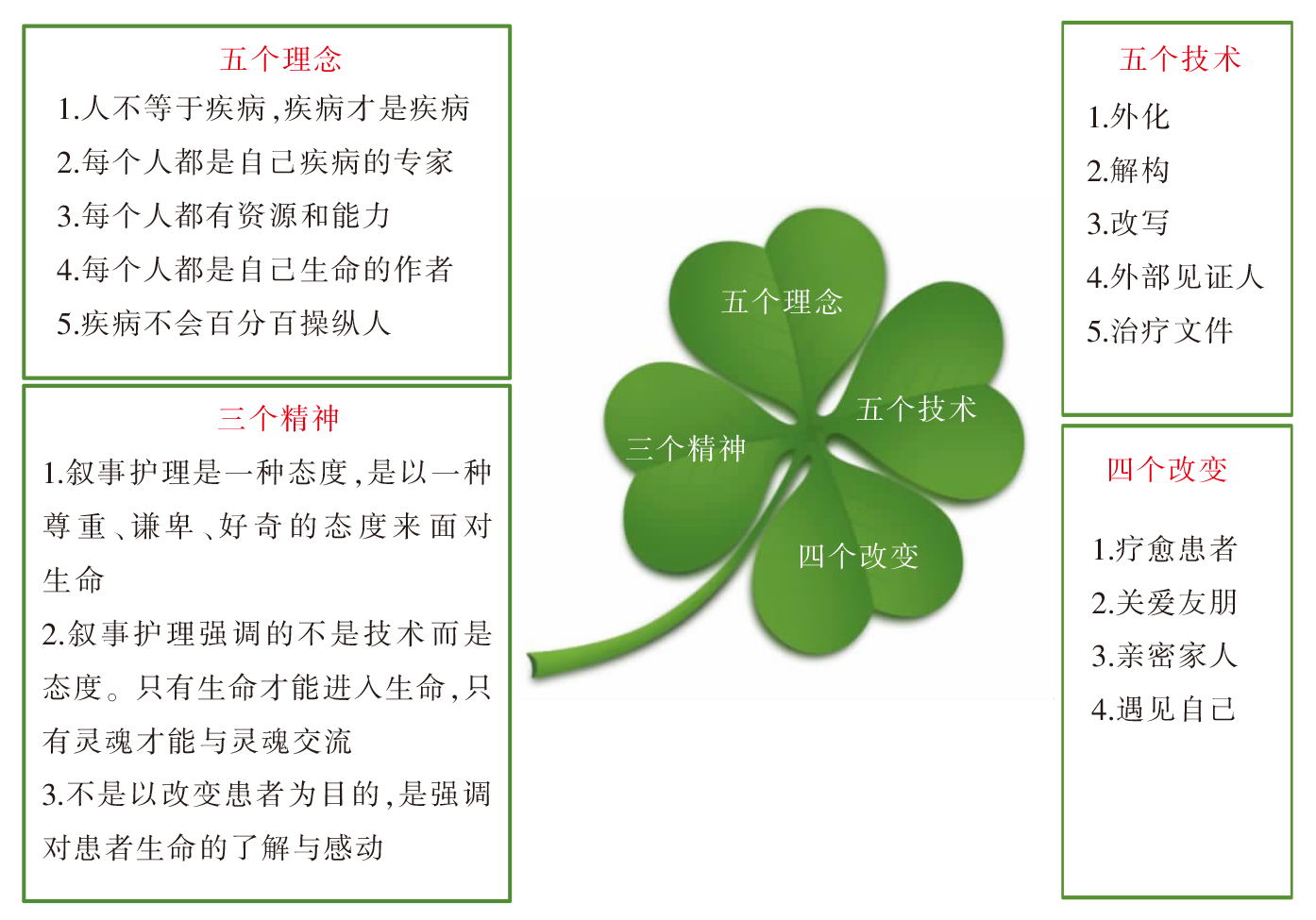
李春. 叙事护理的“3554四叶草”模型[J]. 叙事医学, 2024, 7(6):381-381,386.
|
|
Li C. “3554 four-leaf clover” model of narrative nursing[J]. Narrat Med, 2024, 7(6):381-381,386.
|
| [7] |
Kolb DA. Experiential learning:experience as the source of learning and development[M]. 2nd ed. Upper Saddle River,NJ: Pearson Education, 2015.
|
| [8] |
许娟, 刘义兰. 临床护理人员关怀能力调查分析[J]. 护理学杂志, 2008, 23(3):16-18.
|
|
Xu J, Liu YL. Investigation and analysis of nursing staff’s caring ability[J]. J Nurs Sci, 2008, 23(3):16-18.
|
| [9] |
杨秋菊, 宋佳玮, 张浩为, 等. 医学生安宁疗护教育存在的问题与对策[J]. 中国医学伦理学, 2025, 38(7):937-942.
doi: 10.12026/j.issn.1001-8565.2025.07.19
|
|
Yang QJ, Song JW, Zhang HW, et al. Problems and counter-measures in palliative care education for medical students[J]. Chin Med Ethics, 2025, 38(7):937-942.
|
| [10] |
Cheng J, Wu YT, Huang L, et al. Integrating Kolb’s experien-tial learning theory into nursing education:a four-stage intervention with case analysis,mind maps,reflective journals,and peer simulations for advanced health assessment[J]. Front Med, 2025, 12:1616392.
doi: 10.3389/fmed.2025.1616392
|
| [11] |
Braun V, Clarke V. Using thematic analysis in psychology[J]. Qual Res Psychol, 2006, 3(2):77-101.
doi: 10.1191/1478088706qp063oa
|
| [12] |
Xiao L, Peng DQ, Zhong JD, et al. Storytelling as a trans-formative tool:how narrative-based teaching reshapes clinical education outcomes in vocational nursing internships[J]. Front Med, 2025, 12:1587526.
doi: 10.3389/fmed.2025.1587526
|
| [13] |
Knowles MS, Holton EF, Swanson RA. The adult learner:the definitive classic in adult education and human resource development[M]. 8th ed. New York: Routledge, 2015.
|
| [14] |
李爽, 刘霖, 陈如男, 等. 体验式教学在本科护理专业生命教育课程中的应用[J]. 中华护理教育, 2024, 21(6):662-668.
|
|
Li S, Liu L, Chen RN, et al. Application of experiential teaching in the Life Education course for nursing under-graduates[J]. Chin J Nurs Educ, 2024, 21(6):662-668.
|