ISSN 2097-6054(网络) ISSN 1672-9234(印刷) CN 11-5289/R
主管:中国科学技术协会 主办:中华护理学会
出版:中华护理杂志社
收录:中国科学引文数据库(CSCD)来源期刊
中国期刊全文数据库
中国核心期刊(遴选)数据库
Scopus
主管:中国科学技术协会 主办:中华护理学会
出版:中华护理杂志社
收录:中国科学引文数据库(CSCD)来源期刊
中国期刊全文数据库
中国核心期刊(遴选)数据库
Scopus

中华护理教育 ›› 2026, Vol. 23 ›› Issue (1): 85-94.doi: 10.3761/j.issn.1672-9234.2026.01.013
杨艳丽1( ), 王青1, 马尚红1, 杨庆红1, 丁晓彤2, 王娟3, 李峥2,*()
收稿日期:2025-05-06
出版日期:2026-01-15
发布日期:2026-01-13
通讯作者:
*李峥,E-mail:作者简介:杨艳丽:女,本科(硕士在读),护士,E-mail:yangyl2023@lzu.edu.cn
基金资助:
YANG Yanli1(), WANG Qing1, MA Shanghong1, YANG Qinghong1, DING Xiaotong2, WANG Juan3, LI Zheng2,*()
Received:2025-05-06
Online:2026-01-15
Published:2026-01-13
Contact:
*LI Zheng,E-mail:Supported by:摘要:
目的 系统归纳护士用药中断管理的最佳证据,为临床实践提供指导。方法 遵循“5S”循证模型,系统检索中英文数据库、指南相关网站和中断网站(Interruptions.net)中与用药中断管理相关的文献,包括临床决策、最佳实践、临床实践指南、系统评价、证据总结、专家共识及原始研究。检索时限为建库至2024年12月31日。2名研究者根据明确的纳入和排除标准,独立进行文献筛选、质量评价、证据提取和汇总。结果 最终纳入33篇文献,包括2篇系统评价、3篇随机对照试验和28篇类实验研究。从组织层(5条)、管理层(7条)、个人层(5条)3个维度归纳出17条推荐意见,内容涵盖标准化流程、环境优化、多学科协作及用药中断管理培训等关键要素。结论 基于现有证据,建议从优化用药安全环境、引入用药安全管理系统、强化用药中断管理培训及开展患者和家属中断管理教育等方面入手,有效降低用药中断相关差错发生率,切实保障患者用药安全。
杨艳丽, 王青, 马尚红, 杨庆红, 丁晓彤, 王娟, 李峥. 护士用药中断管理的最佳证据总结[J]. 中华护理教育, 2026, 23(1): 85-94.
YANG Yanli, WANG Qing, MA Shanghong, YANG Qinghong, DING Xiaotong, WANG Juan, LI Zheng. Summary of the best evidence for medication interruption management by nurses[J]. Chinese Journal of Nursing Education, 2026, 23(1): 85-94.
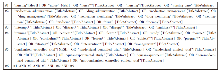
图1
PubMed中护士用药中断原始研究的文献检索策略"
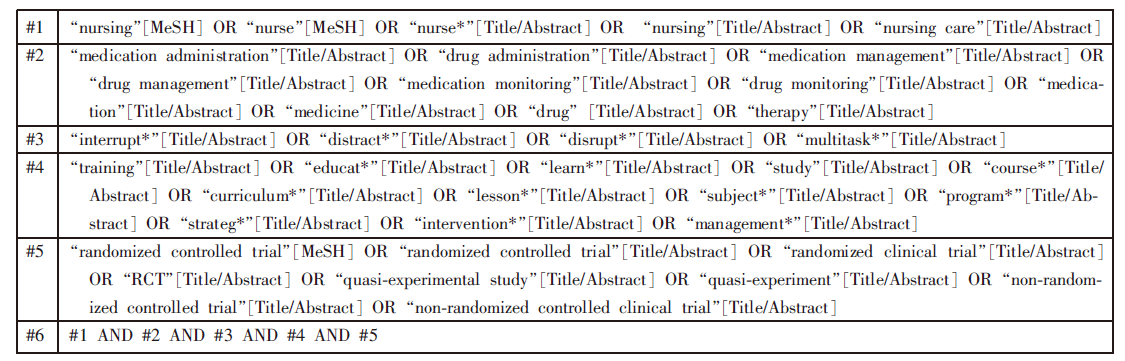

表1
纳入文献一般特征(n=33)"
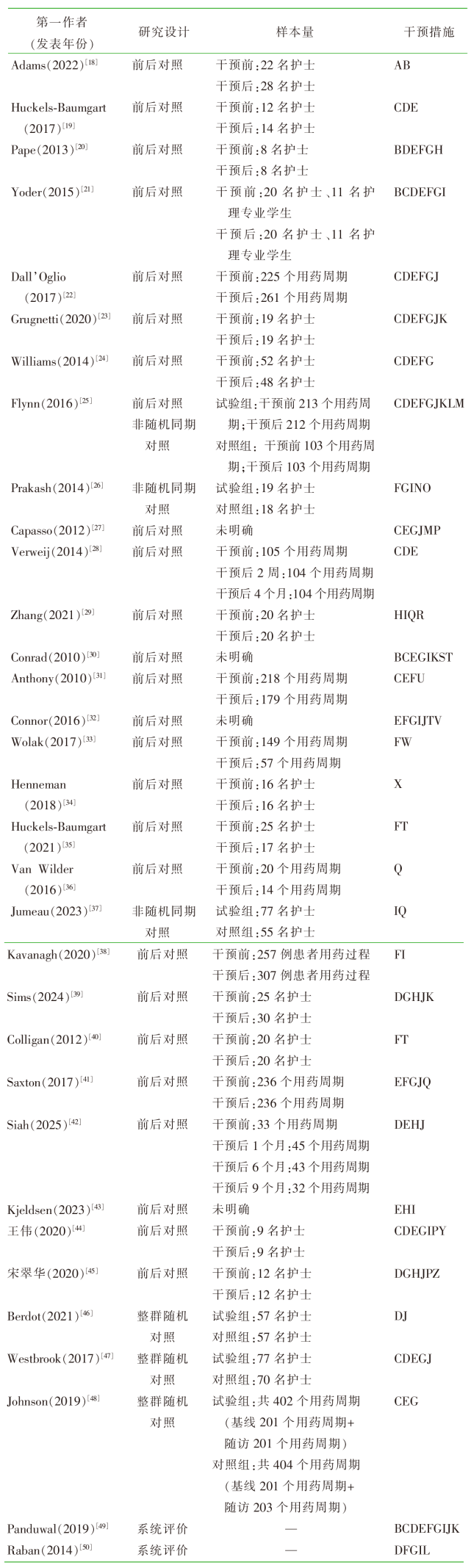 |
表2
用药中断管理的证据总结"
 |
| [1] | World Health Organization. Medication without harm:policy brief[EB/OL].(2024-03-07)[2024-11-12]. https://www.who.int/publications/i/item/9789240062764. |
| [2] | World Health Organization. Global patient safety report 2024[EB/OL].(2024-05-30)[2025-04-07]. https://www.who.int/publi-cations/i/item/9789240095458. |
| [3] |
Raja, Badil, Ali S, et al. Association of medication administra-tion errors with interruption among nurses in public sector tertiary care hospitals[J]. Pak J Med Sci, 2019, 35(5):1318-1321.
doi: 10.12669/pjms.35.5.287 pmid: 31488999 |
| [4] |
Westbrook JI, Woods A, Rob MI, et al. Association of inter-ruptions with an increased risk and severity of medication administration errors[J]. Arch Intern Med, 2010, 170(8):683-690.
doi: 10.1001/archinternmed.2010.65 pmid: 20421552 |
| [5] |
Li SYW, Magrabi F, Coiera E. A systematic review of the psy-chological literature on interruption and its patient safety implications[J]. J Am Med Inform Assoc, 2012, 19(1):6-12.
doi: 10.1136/amiajnl-2010-000024 |
| [6] | 谢建飞, 丁四清, 曾赛男, 等. 护理中断事件的概念分析和启示[J]. 中华护理杂志, 2013, 48(2):175-178. |
| Xie JF, Ding SQ, Zeng SN, et al. Nursing interruptions:a con-cept analysis and implications[J]. Chin J Nurs, 2013, 48(2):175-178. | |
| [7] | 马珂珂, 丁四清, 周建大, 等. 给药中断事件现状及管理对策的研究进展[J]. 护理学杂志, 2018, 33(18):21-24. |
| Ma KK, Ding SQ, Zhou JD, et al. Research progress on inter-ruptions during medication administration and management strategies[J]. J Nurs Sci, 2018, 33(18):21-24. | |
| [8] | 郭佳. ICU护理用药过程中断现状观察及干预指标的制定[D]. 太原: 山西中医药大学, 2020. |
| Guo J. Observation on interruption of ICU nursing medication process and formulation on intervention indicators[D]. Taiyuan: Shanxi University of Traditional Chinese Medicine, 2020. | |
| [9] | 吴钰琦. 用药过程中护理中断事件预防策略的构建[D]. 湖州: 湖州师范学院, 2022. |
| Wu YQ. Construction of nursing interruption prevention strategy during medication[D]. Huzhou: Huzhou University, 2022. | |
| [10] | 朱政, 胡雁, 周英凤, 等. 推动证据向临床转化(三)研究的选题和问题构建[J]. 护士进修杂志, 2020, 35(9):796-799. |
| Zhu Z, Hu Y, Zhou YF, et al. Promoting the transformation of evidence to clinical practice:research topic selection and problem construction[J]. J Nurses Train, 2020, 35(9):796-799. | |
| [11] |
Alper BS, Brian Haynes R. EBHC pyramid 5.0 for accessing preappraised evidence and guidance[J]. Evid Based Med, 2016, 21(4):123-125.
doi: 10.1136/ebmed-2016-110447 pmid: 27325531 |
| [12] | 王志稳, 冷敏敏, 孙月. 证据整合研究中文献检索策略的制订[J]. 中华护理教育, 2021, 18(10):883-888. |
| Wang ZW, Leng MM, Sun Y. Developing high-quality search strategy in evidence synthesis[J]. Chin J Nurs Educ, 2021, 18(10):883-888. | |
| [13] |
Aromataris E, Fernandez R, Godfrey CM, et al. Summarizing systematic reviews:methodological development,conduct and reporting of an umbrella review approach[J]. Int J Evid Based Healthc, 2015, 13(3):132-140.
doi: 10.1097/XEB.0000000000000055 |
| [14] | Barker TH, Stone JC, Sears K, et al. The revised JBI critical appraisal tool for the assessment of risk of bias for randomi-zed controlled trials[J]. JBI Evid Synth, 2023, 21(3):494-506. |
| [15] | Barker TH, Habibi N, Aromataris E, et al. The revised JBI critical appraisal tool for the assessment of risk of bias for quasi-experimental studies[J]. JBI Evid Synth, 2024, 22(3):378-388. |
| [16] |
de Smalen AW, Chan ZX, Abreu Lopes C, et al. Developing an evidence assessment framework and appraising the acade-mic literature on migrant health in Malaysia:a scoping review[J]. BMJ Open, 2021, 11(1):e041379.
doi: 10.1136/bmjopen-2020-041379 |
| [17] | 王春青, 胡雁. JBI证据预分级及证据推荐级别系统(2014版)[J]. 护士进修杂志, 2015, 30(11):964-967. |
| Wang CQ, Hu Y. JBI evidence pre-classification and evidence rank system(2014 edition)[J]. J Nurses Train, 2015, 30(11):964-967. | |
| [18] | Adams J, Waldo K, Brodie M, et al. Chemo checker:transform-ing care and increasing patient safety by reducing nurse distractions[J]. Clin J Oncol Nurs, 2022, 26(1):100-103. |
| [19] |
Huckels-Baumgart S, Niederberger M, Manser T, et al. A com-bined intervention to reduce interruptions during medication preparation and double-checking:a pilot-study evaluating the impact of staff training and safety vests[J]. J Nurs Manag, 2017, 25(7):539-548.
doi: 10.1111/jonm.2017.25.issue-7 |
| [20] |
Pape TM. The effect of a five-part intervention to decrease omitted medications[J]. Nurs Forum, 2013, 48(3):211-222.
doi: 10.1111/nuf.12025 pmid: 23889200 |
| [21] |
Yoder M, Schadewald D, Dietrich K. The effect of a safe zone on nurse interruptions,distractions,and medication administra-tion errors[J]. J Infus Nurs, 2015, 38(2):140-151.
doi: 10.1097/NAN.0000000000000095 |
| [22] |
Dall’Oglio I, Fiori M, Di Ciommo V, et al. Effectiveness of an improvement programme to prevent interruptions during medi-cation administration in a paediatric hospital:a preinterven-tion-postintervention study[J]. BMJ Open, 2017, 7(1):e013285.
doi: 10.1136/bmjopen-2016-013285 |
| [23] |
Grugnetti AM, Caruso R, Scognamiglio D, et al. Effects of im-plementing standardized organizational interventions on drug therapy management(DTM):a quasi-experimental study[J]. G Ital Med Lav Ergon, 2020, 42(1):48-54.
pmid: 32614533 |
| [24] |
Williams T, King MW, Thompson JA, et al. Implementing evi-dence-based medication safety interventions on a progressive care unit[J]. Am J Nurs, 2014, 114(11):53-62.
doi: 10.1097/01.NAJ.0000456433.07343.7f pmid: 25353136 |
| [25] |
Flynn F, Evanish JQ, Fernald JM, et al. Progressive care nurses improving patient safety by limiting interruptions during me-dication administration[J]. Crit Care Nurse, 2016, 36(4):19-35.
doi: 10.4037/ccn2016498 pmid: 27481799 |
| [26] |
Prakash V, Koczmara C, Savage P, et al. Mitigating errors caused by interruptions during medication verification and adminis-tration:interventions in a simulated ambulatory chemotherapy setting[J]. BMJ Qual Saf, 2014, 23(11):884-892.
doi: 10.1136/bmjqs-2013-002484 pmid: 24906806 |
| [27] |
Capasso V, Johnson M. Improving the medicine administration process by reducing interruptions[J]. J Healthc Manag, 2012, 57(6):384-390.
pmid: 23297605 |
| [28] |
Verweij L, Smeulers M, Maaskant JM, et al. Quiet please!Drug round tabards:are they effective and accepted? A mixed method study[J]. J Nurs Scholarsh, 2014, 46(5):340-348.
doi: 10.1111/jnu.2014.46.issue-5 |
| [29] |
Zhang WG, Liu JW, Yang SY, et al. A study on the improvement of nursing interruption risk by a closed-loop manage-ment model[J]. Risk Manag Healthc Policy, 2021, 14:2945-2952.
doi: 10.2147/RMHP.S301108 |
| [30] |
Conrad C, Fields W, McNamara T, et al. Medication room mad-ness:calming the chaos[J]. J Nurs Care Qual, 2010, 25(2):137-144.
doi: 10.1097/NCQ.0b013e3181c3695d |
| [31] |
Anthony K, Wiencek C, Bauer C, et al. No interruptions please:impact of a No Interruption Zone on medication safety in intensive care units[J]. Crit Care Nurse, 2010, 30(3):21-29.
doi: 10.4037/ccn2010473 pmid: 20067939 |
| [32] |
Connor JA, Ahern JP, Cuccovia B, et al. Implementing a dis-traction-free practice with the red zone medication safety initiative[J]. Dimens Crit Care Nurs, 2016, 35(3):116-124.
doi: 10.1097/DCC.0000000000000179 pmid: 27043397 |
| [33] |
Wolak E, Hill A, Ball P, et al. A novel approach to reducing RN distraction during medication access[J]. Medsurg Nurs, 2017, 26(2):93-98.
pmid: 30304588 |
| [34] |
Henneman EA, Marquard JL, Nicholas C, et al. The stay S.A.F.E. strategy for managing interruptions reduces distraction time in the simulated clinical setting[J]. Crit Care Nurs Q, 2018, 41(2):215-223.
doi: 10.1097/CNQ.0000000000000201 pmid: 29494376 |
| [35] | Huckels-Baumgart S, Baumgart A, Buschmann U, et al. Sepa-rate medication preparation rooms reduce interruptions and medication errors in the hospital setting:a prospective obser-vational study[J]. J Patient Saf, 2021, 17(3):e161-e168. |
| [36] |
Van Wilder A, Bell H, Franklin BD. The effect of electronic prescribing and medication administration on nurses’ workflow and activities:an uncontrolled before and after study[J]. Saf Health, 2016, 2(1):13.
doi: 10.1186/s40886-016-0023-8 |
| [37] |
Jumeau M, Francois O, Bonnabry P. Impact of automated dispensing cabinets on dispensing errors,interruptions and pillbox preparation time[J]. Eur J Hosp Pharm, 2023, 30(4):237-241.
doi: 10.1136/ejhpharm-2021-002849 |
| [38] | Kavanagh A, Donnelly J. A lean approach to improve medica-tion administration safety by reducing distractions and inter-ruptions[J]. J Nurs Care Qual, 2020, 35(4):E58-E62. |
| [39] |
Sims T, Narayanan P, Alex A, et al. Decreasing nonemergent nurse interruptions during peak medication administration time utilizing “the golden hour”[J]. J Nurs Care Qual, 2024, 39(2):99-101.
doi: 10.1097/NCQ.0000000000000750 |
| [40] |
Colligan L, Guerlain S, Steck SE, et al. Designing for distrac-tions:a human factors approach to decreasing interruptions at a centralised medication station[J]. BMJ Qual Saf, 2012, 21(11):939-947.
doi: 10.1136/bmjqs-2011-000289 pmid: 22893697 |
| [41] |
Saxton R, Cahill R. Impact of No-interruption intervention on safety and efficiency[J]. J Nurs Care Qual, 2017, 32(4):281-284.
doi: 10.1097/NCQ.0000000000000276 pmid: 28658187 |
| [42] | Siah JW, Cheng CKT, Choy CL, et al. Interruption reduction during oral medication rounds among nurses in hematology-oncology wards:a best practice implementation project[J]. JBI Evid Implement, 2025, 23(3):274-281. |
| [43] |
Kjeldsen LJ, Schlünsen M, Meijers A, et al. Medication dispen-sing by pharmacy technicians improves efficiency and patient safety at a geriatric ward at a Danish hospital:a pilot study[J]. Pharmacy, 2023, 11(3):82.
doi: 10.3390/pharmacy11030082 |
| [44] | 王伟, 赵小静, 王芳, 等. 护士用药过程中中断事件前馈控制方案的构建及应用[J]. 中华现代护理杂志, 2020, 26(33):4618-4623. |
| Wang W, Zhao XJ, Wang F, et al. Construction and applica-tion of feedforward control plan for interruptions of nurses performing drug use[J]. Chin J Mod Nurs, 2020, 26(33):4618-4623. | |
| [45] | 宋翠华, 张秋玲, 李新平, 等. 应用医疗团队资源管理模式进行呼吸科用药护理中断事件的研究实践[J]. 中国医药科学, 2020, 10(11):167-171. |
| Song CH, Zhang QL, Li XP, et al. Practical research on the application of medical team resource management model to the interruption of medication nursing in the department of respiratory medicine[J]. China Med Pharm, 2020, 10(11):167-171. | |
| [46] |
Berdot S, Vilfaillot A, Bezie Y, et al. Effectiveness of a ‘do not interrupt’ vest intervention to reduce medication errors during medication administration:a multicenter cluster rando-mized controlled trial[J]. BMC Nurs, 2021, 20(1):153.
doi: 10.1186/s12912-021-00671-7 pmid: 34429095 |
| [47] |
Westbrook JI, Li L, Hooper TD, et al. Effectiveness of a ‘Do not interrupt’ bundled intervention to reduce interruptions dur-ing medication administration:a cluster randomised controlled feasibility study[J]. BMJ Qual Saf, 2017, 26(9):734-742.
doi: 10.1136/bmjqs-2016-006123 pmid: 28232390 |
| [48] | Johnson M, Langdon R, Levett-Jones T, et al. A cluster rando-mised controlled feasibility study of nurse-initiated behaviou-ral strategies to manage interruptions during medication admi-nistration[J]. Int J Qual Health Care, 2019, 31(8):G67-G73. |
| [49] |
Panduwal CA, Bilaut EC. The effectiveness of interventions to reduce the nurses’ distractions during medication administra-tion:a systematic review[J]. J Ners, 2019, 14(3):132-140.
doi: 10.20473/jn.v14i3.17048 |
| [50] |
Raban MZ, Westbrook JI. Are interventions to reduce interru-ptions and errors during medication administration effective:a systematic review[J]. BMJ Qual Saf, 2014, 23(5):414-421.
doi: 10.1136/bmjqs-2013-002118 |
| [51] |
Hamed MMM, Konstantinidis S. Barriers to incident reporting among nurses:a qualitative systematic review[J]. West J Nurs Res, 2022, 44(5):506-523.
doi: 10.1177/0193945921999449 |
| [52] |
Duruk N, Zencir G, Eşer I. Interruption of the medication pre-paration process and an examination of factors causing interruptions[J]. J Nurs Manag, 2016, 24(3):376-383.
doi: 10.1111/jonm.12331 |
| [53] | Version O. A human factors approach to medication adminis-tration in nursing homes[D]. Stavanger: University of Stavan-ger, 2020. |
| [54] |
续璐, 刘慧, 谢怡琼, 等. 医疗机构用药安全的风险因素及其应对策略[J]. 医药导报, 2022, 41(8):1102-1107.
doi: 10.3870/j.issn.1004-0781.2022.08.006 |
| Xu L, Liu H, Xie YQ, et al. Risk factors and strategies of medication safety in medical institutions[J]. Her Med, 2022, 41(8):1102-1107. | |
| [55] | 刘佳微, 张文光. 重症监护室护理中断事件现况及与护士心理负荷的相关性[J]. 护理学杂志, 2019, 34(19):8-11. |
| Liu JW, Zhang WG. Correlation between nursing interruptions in intensive care unit and nurses’ psychological load[J]. J Nurs Sci, 2019, 34(19):8-11. | |
| [56] |
Thomas L, Donohue-Porter P, Stein Fishbein J. Impact of interruptions,distractions,and cognitive load on procedure failures and medication administration errors[J]. J Nurs Care Qual, 2017, 32(4):309-317.
doi: 10.1097/NCQ.0000000000000256 pmid: 28448299 |
| [57] |
Jin HZ, Liu LY, Luo ZB, et al. The effects of different inter-ruption conditions on mental workload:an experimental study based on multimodal measurements[J]. Ergonomics, 2025, 68(8):1274-1292.
doi: 10.1080/00140139.2024.2400129 |
| [58] |
Johnson M, Sanchez P, Langdon R, et al. The impact of inter-ruptions on medication errors in hospitals:an observational study of nurses[J]. J Nurs Manag, 2017, 25(7):498-507.
doi: 10.1111/jonm.2017.25.issue-7 |
| [1] | 裘云霞, 林伊慧, 唐林霞, 贾盈盈, 马小琴. 情绪释放疗法在癌症患者中应用的范围综述[J]. 中华护理教育, 2026, 23(2): 249-256. |
| [2] | 杨素珍, 魏锦轩, 王颖, 李颖, 仲伟娜, 张欣雨, 崔永军, 程海荣. 维持性血液透析患者衰弱风险预测模型的系统评价[J]. 中华护理教育, 2026, 23(1): 101-109. |
| [3] | 陈少华, 刘宇, 黄菲菲, 邱萍萍, 胡荣, 宋继红. 融入整合性知识转化的循证护理学课程的教学设计与应用研究[J]. 中华护理教育, 2026, 23(1): 42-48. |
| [4] | 盛贵箫, 桑明, 梅彬彬, 杨丽萍. 非酒精性脂肪性肝病非药物管理的证据总结[J]. 中华护理教育, 2025, 22(9): 1133-1140. |
| [5] | 黄晓娇, 谭艳, 戚熠. 基于证据的肝癌患者术后饮食管理科普作品的研制及应用[J]. 中华护理教育, 2025, 22(8): 1013-1019. |
| [6] | 刘书婷, 郝敏, 陈佩玲, 夏雪迎, 宋子成, 胡佳佳, 赵薇. 系统性红斑狼疮患者出院准备服务方案的构建及效果评价[J]. 中华护理教育, 2025, 22(6): 732-739. |
| [7] | 张赛雅, 孙仪泽, 赵天芮, 葛艳红, 李萍, 张丽华. 中文版成人药物素养评估工具的系统评价[J]. 中华护理教育, 2025, 22(4): 478-485. |
| [8] | 温燕玲, 杨静雯, 王鲁星, 王婷婷, 赵妍敏, 王华芬. 造血干细胞移植并发胃肠道急性移植物抗宿主病患者营养管理的最佳证据总结[J]. 中华护理教育, 2025, 22(4): 494-501. |
| [9] | 徐文琪, 韩慧敏, 郭畔旭, 刘颖珂, 刘京辉, 李小利, 杨长永, 章明阳. 腹膜透析患者容量管理的最佳证据总结[J]. 中华护理教育, 2025, 22(3): 371-378. |
| [10] | 张方圆, 焦杰, 刘丽峰. 肺癌患者术前预康复管理的最佳证据总结[J]. 中华护理教育, 2024, 21(7): 881-886. |
| [11] | 王乐欣, 荆佳美, 黄志红, 赵晶晶, 程芳, 尚娅萌, 卫晓静. 使用支撑面预防压力性损伤的证据总结[J]. 中华护理教育, 2024, 21(6): 738-744. |
| [12] | 郭栋, 付秀荣, 李恒. 手术物品清点环节护理中断事件的危险因素分析[J]. 中华护理教育, 2024, 21(5): 574-579. |
| [13] | 顾梦倩, 黄怡丹, 黄岚卉, 杨诗怡, 吴海珍, 邹君俊, 郁嘉娴. 成人ICU患者医用粘胶相关性皮肤损伤预防与管理最佳实践的障碍因素分析[J]. 中华护理教育, 2024, 21(5): 599-605. |
| [14] | 朱松颖, 谭然, 高蔚. 成人PICC/上臂输液港原发性导管异位管理的最佳证据总结[J]. 中华护理教育, 2024, 21(5): 613-619. |
| [15] | 张婕, 李秀川, 刘春芳, 汤琪, 蒋婕, 霍蕊, 季红敏. 肠造口患者皮肤黏膜分离预防与护理的证据总结[J]. 中华护理教育, 2024, 21(4): 486-491. |
|
||
